
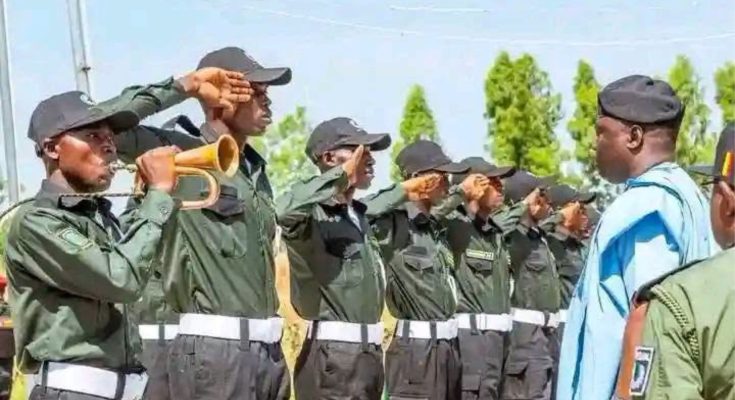

Taraba Restructures Marshals into Disciplined Grassroots Security Force
From Denis Akpen, Jalingo
JALINGO, Nigeria — Taraba State has overhauled its community security outfit, the Taraba Marshals, transforming it from a local response group into a structured, law-backed security architecture under the vision of Governor Agbu Kefas.
You May Also Like
Spearheading the operational transition is Commander General Agyole Abeh, a retired Commissioner of Police with 35 years of law enforcement experience in Anambra and Kaduna States. Under his command, the outfit is bridging the gap between community-rooted vigilantes and conventional state security agencies.
To build a professional command structure, the state screened over 100 retired military and paramilitary officers, selecting fewer than 50 as Local Government Area (LGA) Commanders based on integrity and competence. Personnel also undergo regular discipline and operational training at the NYSC Orientation Camp.
To enhance grassroots mobility, the state government recently distributed approximately 200 motorcycles evenly across every LGA alongside patrol vehicles, allowing personnel to conduct local patrols in hard-to-reach rural terrain.
Unlike informal vigilante groups, the Marshals operate under the statutory authority of the Taraba Marshal Act. Section 4 of the law grants personnel explicit powers to conduct 24/7 patrols, establish night checkpoints, enter premises during hot pursuit of fleeing suspects, collaborate on search warrants, and make citizen arrests before immediately transferring suspects to the police.
A re-enactment bill is currently before the Taraba State House of Assembly to formally integrate local hunter and vigilante groups into this legal framework.
The Marshals rely heavily on localized intelligence by recruiting personnel from specific wards and deploying them back to their home communities. The outfit currently maintains 21 operational camps in forest zones—including a dedicated base at Pande in Donga LGA—and regularly partners with the Nigerian Army, Police, DSS, Anti-Kidnapping Unit, and NDLEA on joint operations.
Addressing internal accountability, Abeh emphasized a zero-tolerance policy for misconduct, noting that the command does not internally investigate capital offenses. Following a recent incident in Gashaka involving a suspect’s death in custody, the involved Marshal was immediately arrested and transferred to the State Criminal Investigation Department (CID) for prosecution.
The command has also resolved administrative bottlenecks that previously delayed recruit payments due to missing Bank Verification Numbers (BVNs) across a batch of over 900 personnel. With standard public sector budgeting procedures completed, three months of salary arrears have been fully disbursed, alongside operational allowances and free uniforms.
Looking ahead, officials state the Taraba Marshals are positioned to serve as the foundational framework for state policing if enabling federal legislation is passed by the National Assembly, with personnel set to undergo further national screening to align with federal standards.