
Aondoakaa’s 2027 Governorship Bid Faces Legal Hurdle as INEC Says It Is Bound by Supreme Court Ruling
By our Judicial Correspondent
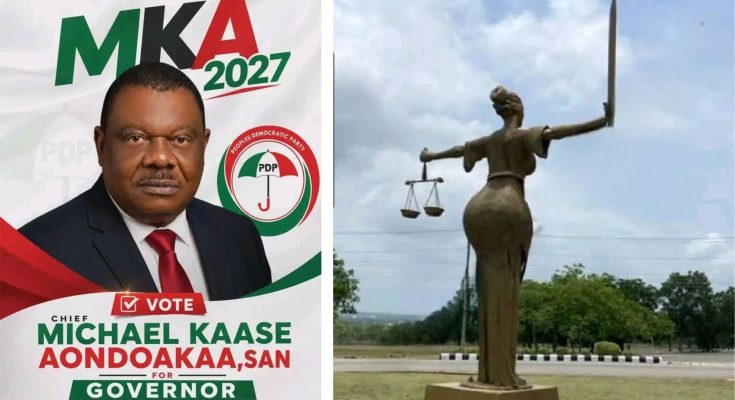
The ambition of former Attorney-General of the Federation, Chief Michael Kaase Aondoakaa, SAN, to become Governor of Benue State in 2027 has run into a legal challenge at the Federal High Court, Abuja. The Independent National Electoral Commission (INEC) has now told the court it is constitutionally obliged to obey a Supreme Court judgment which, the plaintiffs argue, bars him from holding any public office.
You May Also Like
In Suit No. FHC/ABJ/CS/2152/2026, four plaintiffs, David A. Ejembi, Aondoaver Teryila, Joseph Okpanachi and Benedict Akaazua Orkume, sued INEC, the Peoples Democratic Party (PDP) and Chief Aondoakaa as 1st, 2nd and 3rd defendants respectively. Their originating summons, filed on September 9, 2026, asks the court to interpret sections 235, 287(1) and 318(1) of the 1999 Constitution. They want a declaration that INEC must comply with the Supreme Court’s decision in Aondoakaa v. Obot (2022) 5 NWLR (Pt. 1824) 523 by stopping Aondoakaa from contesting the 2027 governorship election in Benue State.
At the centre of the suit is a remark by the Supreme Court in that case. In the lead judgment, Justice Kudirat Kekere-Ekun, now Chief Justice of Nigeria, described it as highly reprehensible for a Chief Law Officer of the Federation to counsel disobedience to a final judgment. She agreed with the trial judge, as affirmed by the Court of Appeal, that given his conduct in that office, Aondoakaa “ought not be entrusted with any other public office at all.”
INEC’s response
In a written address dated and filed on September 28, 2026, INEC’s counsel, Idris Yakubu, Esq., of Beachcroft Solicitors, framed a single issue for determination: whether INEC is under a constitutional obligation to comply with the Supreme Court’s judgment. The commission answered that question in the affirmative.
INEC relied on section 287(1) of the Constitution, which requires all authorities and persons to enforce Supreme Court decisions, and on section 235, which makes those decisions final. It cited a line of apex court authorities, including Kanawa v. INEC (2022), Oye v. Odidan (2025) and Governor of Kwara State v. Adeniyi (2021). According to the commission, the requirement that Supreme Court decisions bind “every authority or person in Nigeria” covers all the defendants in the suit.
The commission further argued that the office of Governor is a public office. It cited Aroyame v. Governor of Edo State (2023) and Nyame v. FRN (2021), where the Supreme Court held that a governor is a public officer under the Constitution and the Code of Conduct provisions.
INEC also referred to an exhibit in which, it said, Justice A.R. Mohammed had found an attempt by Aondoakaa to disparage the judiciary. It urged the court to stop what it called a deliberate and unconstitutional attempt. The commission concluded that, as a law-abiding body and a creation of the law, it would be bound by the decision of the court.
What lies ahead
INEC’s position is significant. The body that will conduct the 2027 election has effectively aligned itself with the plaintiffs’ reading of the Supreme Court judgment. The final word, however, rests with the court. Key questions remain open: whether the apex court’s remark operates as a binding legal disqualification, and whether it can stand alongside the qualification and disqualification provisions for governors in sections 177 and 182 of the Constitution.
The PDP’s and Chief Aondoakaa’s responses to the suit were not available at press time.